How much does a custom 3D product configurator cost?
What a custom 3D product configurator costs: eight cost factors, three scope tiers you can try, published market prices, running costs and how to start.
Short answer: the price depends on how many products and variants the configurator covers, the rules and checks it enforces, what the buyer gets at the end, where the enquiry goes and how it is embedded, plus hosting and care after launch. Published prices range from small monthly app fees to six-figure implementations. Modelwright quotes a fixed price after a short scoping exchange.
For orientation: at Modelwright, a 3D view of one product family (Package A, up to two models) starts at EUR 1,990 one-time, and a configurator with rules and an enquiry starts at EUR 5,400 one-time plus EUR 199 a month for hosting and care. All prices in EUR, excluding VAT; the binding fixed price follows scoping.
This guide is written for the people who sign off the budget: managing directors, heads of sales or e-commerce, and procurement at manufacturers. It explains what actually drives the cost, shows three scope levels you can try in the browser, and lists what vendors publish about their own prices.
The eight factors that set the price
No two configurators cost the same, because no two products need the same work. These eight factors explain most of the difference. Use the last column to brief any vendor, not just us.
| Cost factor | Lower effort | Higher effort | What to ask yourself |
|---|---|---|---|
| 1. Products in scope | One product family with shared parts | Several ranges, each with its own geometry | Which family sells most, or causes the most questions? |
| 2. Variants and parameters | Fixed sizes, a handful of colours | Stepless dimensions, modules that snap together, geometry that rebuilds with every change | Do your dimensions change in steps or freely? |
| 3. Data you already have | Dimensioned drawings, or CAD that is suitable for the web | Heavy CAD assemblies that need simplifying, or photos only of a complex mechanism | Could you send one STEP file or drawing for a check? |
| 4. Rules and engineering checks | A few combinations that are simply not offered | Dependencies between options, fit and clearance checks, a suggested fix when something does not fit | Which rule causes the most back-and-forth in sales today? |
| 5. Explanatory views | Turn, zoom and switch colours | Exploded view, cut-away, running mechanism, assembly sequence | What does a buyer need to understand, not just see? |
| 6. What the buyer gets at the end | A summary to copy into an email | A PDF with views and checks, a parts list, an example price from your price rules | What does your sales team need to reply without a follow-up call? |
| 7. Where enquiries go | Email to one sales inbox | A webhook into your CRM, or routing to the right dealer | Who answers an enquiry today, and in which system? |
| 8. Integration, languages and units | A standalone page in one language | Embedded in your shop and driven by its buy box, several languages, metric and imperial units, analytics events | Where will buyers meet the configurator, and in which markets? |
Hosting and maintenance after launch are a separate line. They are covered in running costs below.
Three scope levels you can try
The quickest way to judge scope is to use something at each level. All examples below are Modelwright's own demos: example configurators with fictional products and example values, built with our own geometry. They are not products of any real manufacturer, and their prices and checks are not quotes or ratings.
1. Viewer: show the product, no rules
A viewer lets buyers turn, zoom and switch finishes. The effort sits in the model and its materials, not in logic.
- The cosmetics bottle switches shape between round and square, glass between clear, frosted and amber, and lets the visitor type a brand name onto the label and unscrew the closure.
- The planetary gearhead runs the drive at an adjustable input speed and adds a cut-away view, an exploded view and item numbers on the parts. Its technical data are sample values.
2. Configurator with rules and an enquiry
Here the configurator knows what can be built. That adds logic, and every rule needs test cases that prove it works.
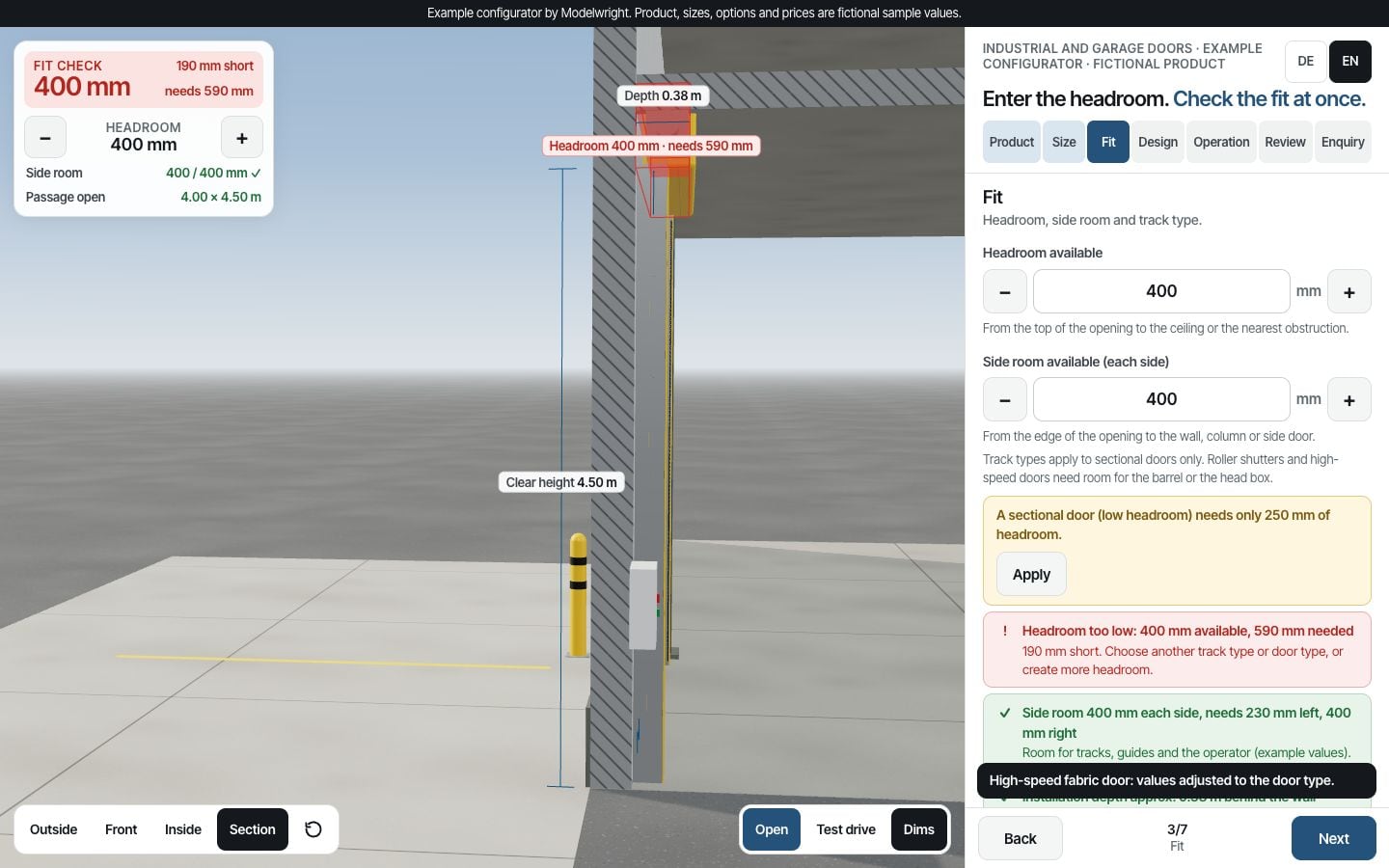
- The sectional and roller door configurator compares the headroom and side room the buyer enters with what each track type needs. It shows the shortfall in millimetres and suggests a track type that fits, applied with one click. In our own QA, the fit check was recomputed independently for 11 configurations and the one-click suggestion was checked in 9 cases [8]. That kind of testing is part of what a rule costs.
- The chemical and hazmat store configurator shows a live sump readout against an example rule, marks the shortfall in litres in red, and blocks invalid combinations: a sliding door is disabled with a hint where it cannot be fitted. The summary, the enquiry text and the PDF carry the same rows.
3. Planner with checks, parts list and example price
A planner places the product in a space and produces the list of parts behind it. This is the largest scope: layout logic, collision or clearance checks, and a parts list mapped to your article numbers and price rules.
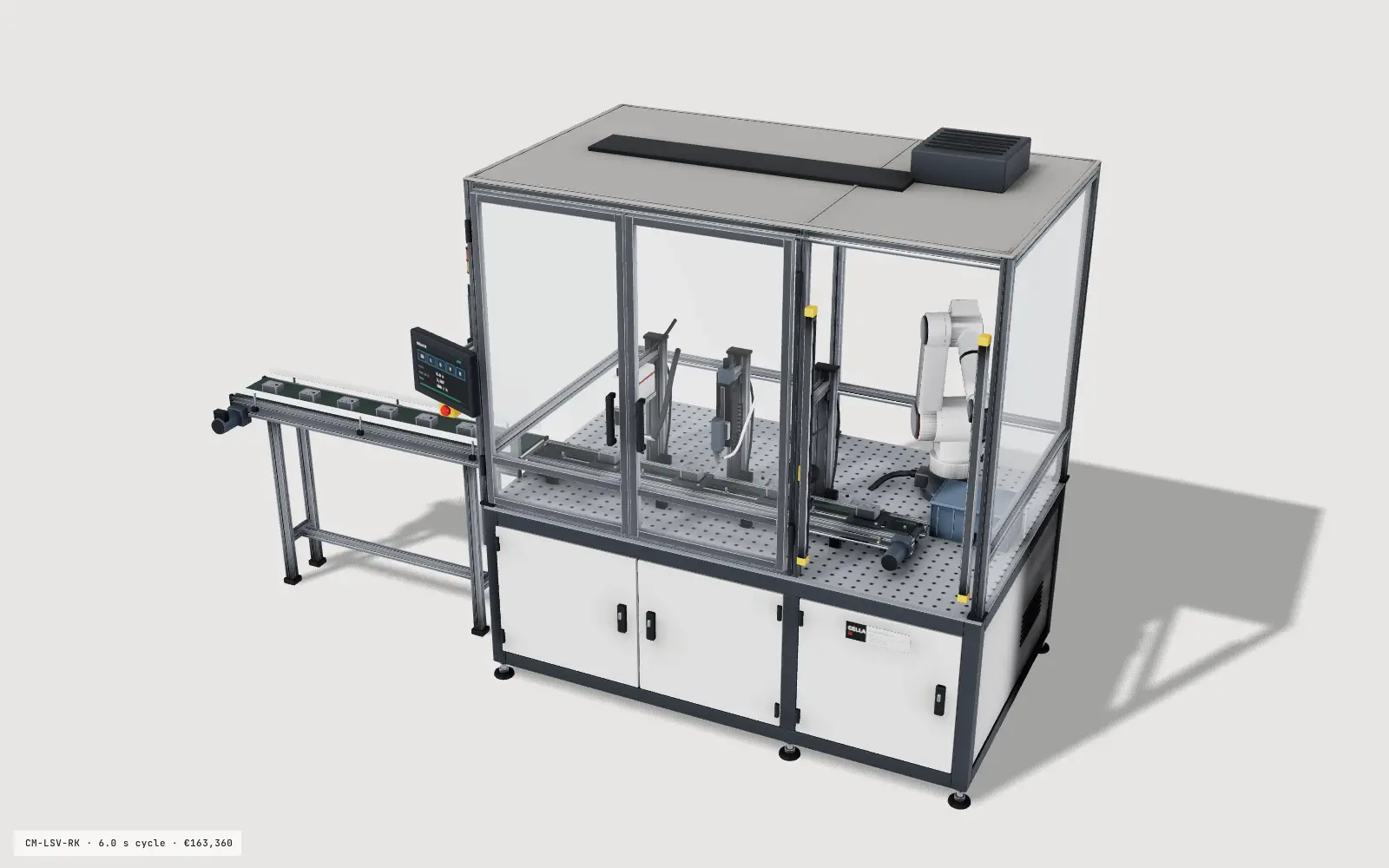
- The modular automation cell puts laser, screwing and inspection modules into three slots, allows the robot only with a fence and light curtain, warns when the line height leaves the 800–1000 mm range, checks service and door-swing areas in the hall and keeps a parts list with example prices.
- The modular sofa checks room width, walkway, door swing and delivery through the door in green, amber or red, and shows a module list with an example price.
Modelwright's packages (all prices in EUR, excluding VAT):
| Scope level | Package | Price | Included |
|---|---|---|---|
| Viewer | Package A | from EUR 1,990 one-time | A 3D view of one product family with up to two models, built from your drawings, photos or CAD and embedded in your website. Hosting by us optional: EUR 19 a month. |
| Configurator with rules and an enquiry | Configurator | from EUR 5,400 one-time + EUR 199 a month | Your options and rules for one product family; a summary and an enquiry carrying the full configuration, by email or webhook; your brand. Monthly: hosting, care and small changes up to 1 hour. |
| Planner with checks | Complete | from EUR 8,880 one-time + EUR 249 a month | The full scope for your range, for example checks, a parts list, an example price or explainer views; the exact scope is in the fixed-price quote. Monthly: hosting, care and small changes up to 2 hours. |
Add-ons: extra model or variant EUR 790; CRM hand-over EUR 490 + EUR 9 a month; other extensions are priced in the fixed-price quote. VAT is charged where applicable; we do not offer USD or GBP prices. "From" means the packages cover one product family; large ranges, ERP integration, CPQ and AR are not included. We give the fixed price after scoping, in writing, with no extra charges for the agreed scope.
What published market prices look like
Most vendors do not publish a price for a configurator. Those that do sell different things, so read the table as context, not as a benchmark. All figures were read on the vendors' own pages on 14 November 2026 and may have changed since.
| Vendor | What it sells | Published price |
|---|---|---|
| Kickflip | Product personalisation app for online shops | From $59/month plus 1.95% to 0% per custom product sold; quote requests +$99/month; white-label +$49/month [1] |
| Roomle | 3D, AR and configurator platform | 3D & AR viewer from €100/month; "Basic" variant configurator from €850/month; "Full Logic" modular configurator from €1,450/month (billed yearly, excluding taxes) [2] |
| Combeenation | CPQ and configurator platform | Licence from €697/month plus a one-time implementation fee, which the vendor puts at around €10,000 for a single configurator and €100,000 or more for comprehensive CPQ with ERP integration [3] |
| Threekit | Visual configuration platform | "Pricing is custom" [4] |
| SaleSqueze | Template configurators for made-to-order outdoor living | No price on its website; it states "$0 setup costs" [5] |
Why these numbers are hard to compare with a custom build:
- Platforms charge a recurring licence. You configure your product inside their system, and the fee continues as long as you use it. Some add a share of sales or extra fees for features such as quote requests.
- Implementation is often extra. A low monthly fee can sit next to a substantial one-time project, as Combeenation's own figures show [3].
- A custom build is mostly a one-time cost. Hosting and maintenance come on top as a smaller monthly fee.
- Your own time counts. With a platform, your team usually builds and maintains the products in an editor. With a custom build, the vendor does that work.
A fair comparison therefore looks at the total over the period you expect to use the configurator, three years for example: licence or build cost, implementation, internal hours and changes.
Template software or custom build: where the money goes
If an off-the-shelf tool covers your product, it may be the simpler choice. A custom build pays off when your product needs its own rules, checks or views that a template cannot handle.
| Template or platform software | Custom build | |
|---|---|---|
| Start | Fast when your product matches a template. Vertical vendors exist for specific industries, for example SaleSqueze for outdoor living (244 templates, its own claim) [5] and IdeaRoom for sheds, carports and post-frame buildings [6]. | Starts with scoping. The model is built from your drawings, photos or CAD. |
| Geometry | The template's or your own uploaded models, within the platform's rules | Your product, part by part |
| Rules and checks | As deep as the platform's rule editor allows | Written for your engineering rules, including fit and clearance checks |
| Maintenance | Usually by your team in the vendor's editor | By the vendor; Modelwright does not offer a self-service editor as standard |
| Cost pattern | Recurring licence, sometimes plus implementation | Mostly one-time, plus a monthly fee for hosting and maintenance |
Makers of sheds, garden rooms, carports and pergolas meet this choice most often. Our guide to configurator software for outdoor buildings compares the options for that market.
Running costs after launch
A configurator is not finished on launch day. Budget for these items:
- Hosting. Depending on the vendor, the files can run on your own server or on the vendor's hosting; at Modelwright, a 3D view (Package A) can run from your server, while configurators are hosted by us in Germany. In the project we built for ALUXIL, a company related to Modelwright, every file is served from aluxil.de: no third-party requests and no cookies. See the ALUXIL case study.
- New products and variants. Each new model or option is a small build of its own.
- Price and rule updates. If the configurator shows prices or parts lists, someone has to keep them in line with your price list.
- Browser and device changes. Web 3D runs on WebGL, which is supported by browsers covering 97.29% of global usage according to caniuse (WebGL 2.0, StatCounter data for October 2026) [7]. Browsers still change, so plan for occasional checks.
With Modelwright, hosting and care are part of the Configurator and Complete packages: EUR 199 or EUR 249 a month (excluding VAT). That covers hosting on our server in Germany, delivered via Cloudflare, technical care, and small changes of up to 1 or 2 hours a month, such as new colours, texts or prices. Care runs for at least 12 months from go-live and can then be cancelled monthly. When the contract ends you receive your data and models as files (glTF, JSON). For a 3D view (Package A), hosting by us is optional (EUR 19 a month); the view can also run from your own server.
How long it takes
Duration depends on the same factors as cost. We give you the timeline together with the fixed-price quote. A Modelwright project runs in six steps:
- Email: you tell us what a buyer should understand, compare or choose.
- Materials: photos, dimensions, drawings or samples, plus CAD if you have it. We check what is usable before we start.
- Fixed-price quote for the build and, for configurators, for hosting and care.
- Model and features, exactly as agreed in the quote.
- Review through a private link on your own devices, with revisions.
- Go live as its own page or embedded in your website or shop.
What speeds things up on your side: one person who decides, rules written down (a spreadsheet is fine) and data sent in one go.
Starting small: one product family first
You do not have to configure the whole range at once. Starting with one product family keeps the first budget small and shows quickly whether the approach works for your buyers. Before you extend, check:
- Do buyers open the 3D and use the options? Analytics events can be set up per project.
- Do enquiries arrive complete, so sales can reply without a clarifying call?
- Can the model and the rules be reused for the next family?
The Modelwright pilot: for EUR 2,900 one-time (excluding VAT, fixed price) we build a configurator for one product family from your data in six weeks and check with you whether buyers and your sales team use it. If you order the configurator within 60 days after the pilot, the full EUR 2,900 is credited.
What a vendor needs for a reliable quote
- The product or family you want to start with, and links to its current pages
- The options and variants, with the combinations that are not allowed
- The hardest rule: the check that causes the most questions in sales
- The data you have: photos, dimensioned drawings, CAD exports (STEP, IGES or native)
- What the buyer should receive at the end: summary, PDF, parts list or example price
- Where enquiries should go: email, CRM or dealers
- Where it will live: standalone page, your website or your shop, and in which languages and units
- Whether you want hosting and updates after launch
If your product is designed in CAD, our guide on turning CAD files into a web 3D configurator explains what we check before quoting.
How Modelwright prices a project
Modelwright builds each configurator for one product or system; we do not sell a template that your product has to fit into. After the first exchange by email you receive a fixed-price quote that spells out what you get. It usually covers:
- the 3D model of your product, built from your materials
- the agreed options, rules and views
- controls that match your site, or none at all if your shop drives the configurator
- a preview image or video that shows until the 3D starts
- review rounds through a private link
- go-live as a standalone page or inside your website or shop; for configurators, with hosting and care by us
Depending on the project we also set up enquiries by email or webhook, your pricing rules, extra languages and analytics events. We do not offer an AR view, an editor for maintaining products yourself, quote PDFs and CPQ, or ERP integration as standard. If you need one of these, we assess it case by case.
A real example of scope: for ALUXIL, a company related to Modelwright, we built a 3D model that sits next to the price on aluxil.de since 16 September 2026. It covers three systems with 152 combinations and four explanatory views. It has no buttons of its own and follows the shop's buy box, so it cannot contradict the price.
More on what we build: custom 3D configurator development. Examples by industry: 3D product configurators for manufacturers.
Common questions
What do Modelwright's packages cost?
A 3D view of one product family (Package A, up to two models) from EUR 1,990 one-time. A configurator with rules and an enquiry from EUR 5,400 one-time plus EUR 199 a month; the Complete package from EUR 8,880 one-time plus EUR 249 a month. A six-week pilot costs EUR 2,900 and is credited in full if you order the configurator within 60 days. All prices in EUR, excluding VAT; the binding fixed price follows scoping.
Is a 3D viewer cheaper than a configurator?
Usually, yes. A viewer needs a good model and materials, but no rules, checks or enquiry logic. You can start with a viewer for one product and add options later.
Do we need CAD data?
No. Photos, dimensions and drawings are usually enough. Existing CAD can help if it suits the web, and we check that before we quote.
Can the configurator send a binding quote?
Our configurators can produce a summary, an enquiry text and a PDF of the configuration for your sales team. Binding quote documents and CPQ are not part of our standard scope.
Who maintains it after launch?
We do. For the Configurator and Complete packages, hosting and care are part of the monthly fee; for a 3D view (Package A) they are optional. There is no self-service editor as standard, so changes to products, rules or prices are made by us.
Sources
- Kickflip, pricing page, read 14 November 2026: gokickflip.com/pricing
- Roomle, pricing page, read 14 November 2026: roomle.com/en/pricing
- Combeenation, pricing page, read 14 November 2026: combeenation.com/en/pricing
- Threekit, pricing page, read 14 November 2026: threekit.com/pricing
- SaleSqueze, homepage, read 14 November 2026: salesqueze.com
- IdeaRoom, homepage, read 14 November 2026: idearoom.com
- WebGL 2.0 browser support, caniuse, read 14 November 2026: caniuse.com/webgl2
- Demo features: the "Live in this demo" lists on each linked library page; QA test counts from Modelwright's own QA records (13 November 2026)
Read next
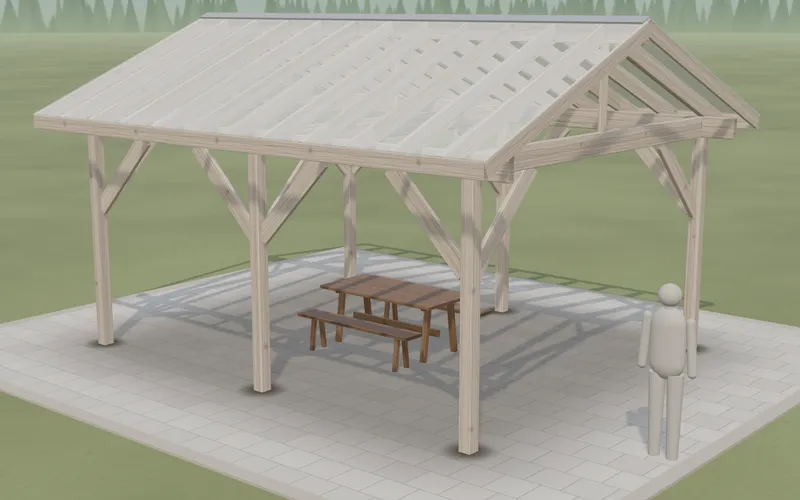
Configurators for halls, pavilions and modular buildings: scope, cost drivers and worked examples
What drives the cost of a configurator for steel halls, pavilions, guard booths, restroom blocks and site cabins, with year-one and three-year examples.
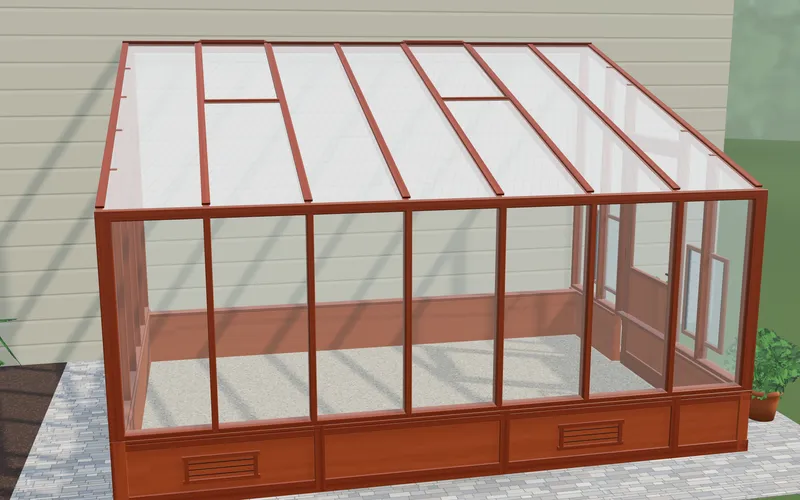
Configurator cost for garden buildings, glamping and saunas: cost drivers, worked examples, buying questions
What makes a configurator for garden buildings, glamping structures or saunas cost more, three worked examples over three years, and buying questions.
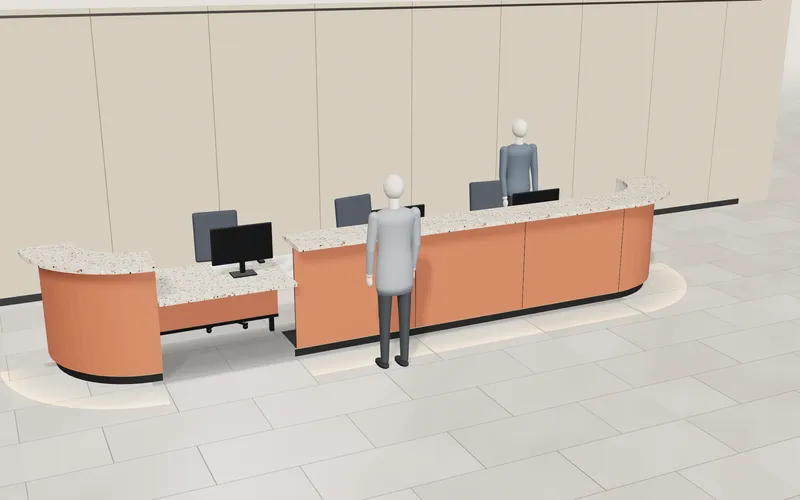
Furniture configurator cost: cost drivers, worked examples and buying questions
What makes a configurator for furniture, kitchens and contract or hospitality interiors cost more, three worked examples over three years, buying tips.